

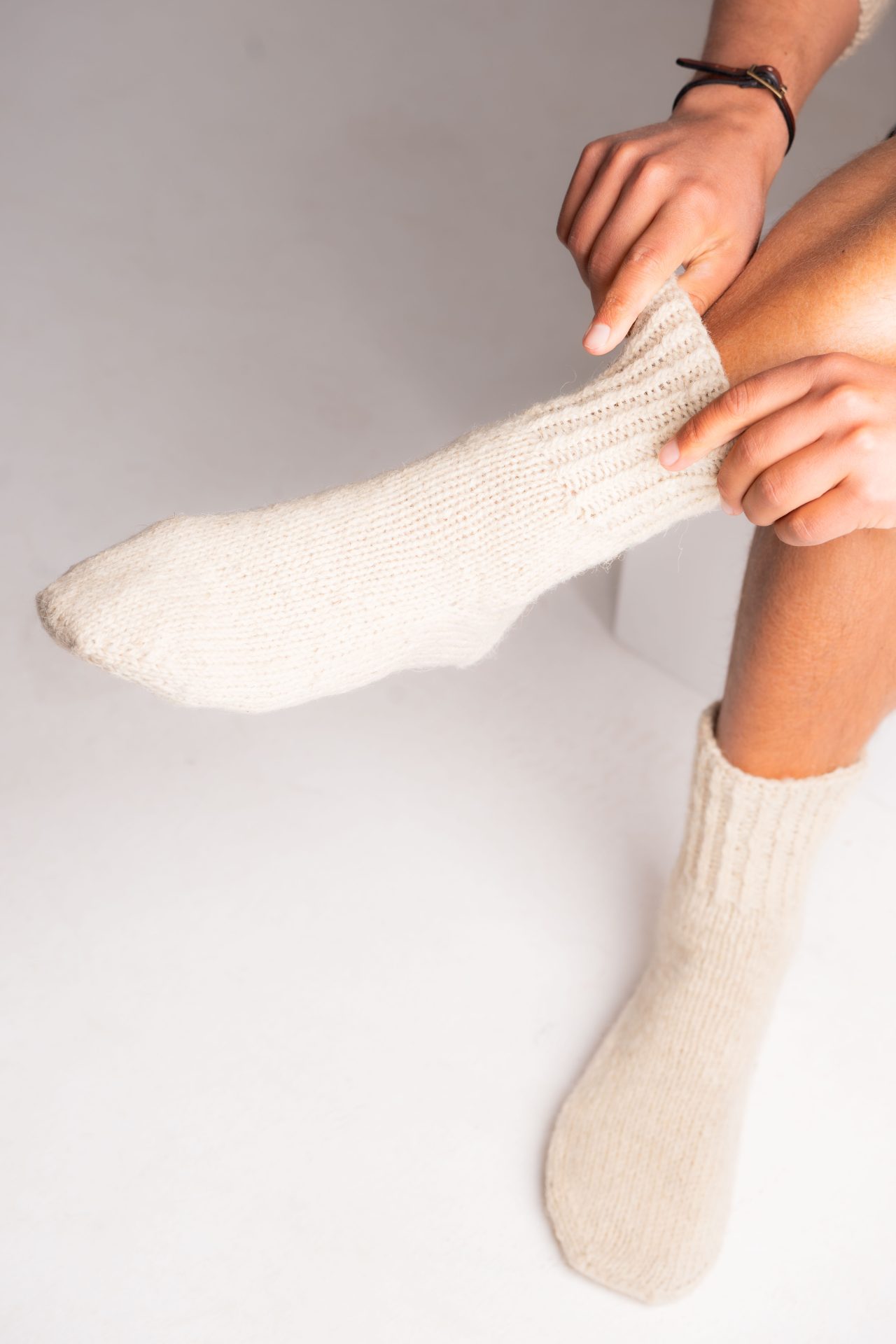
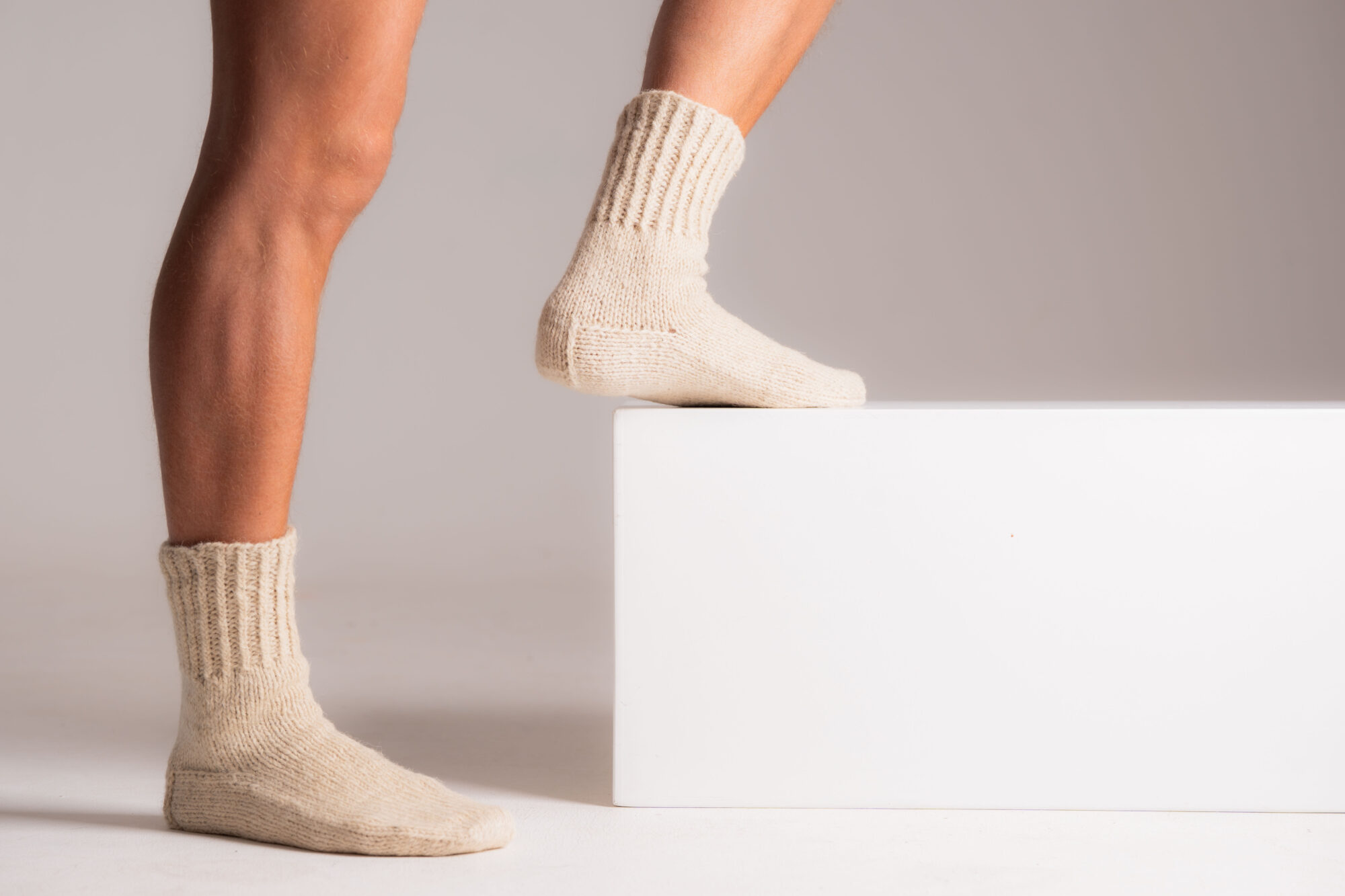
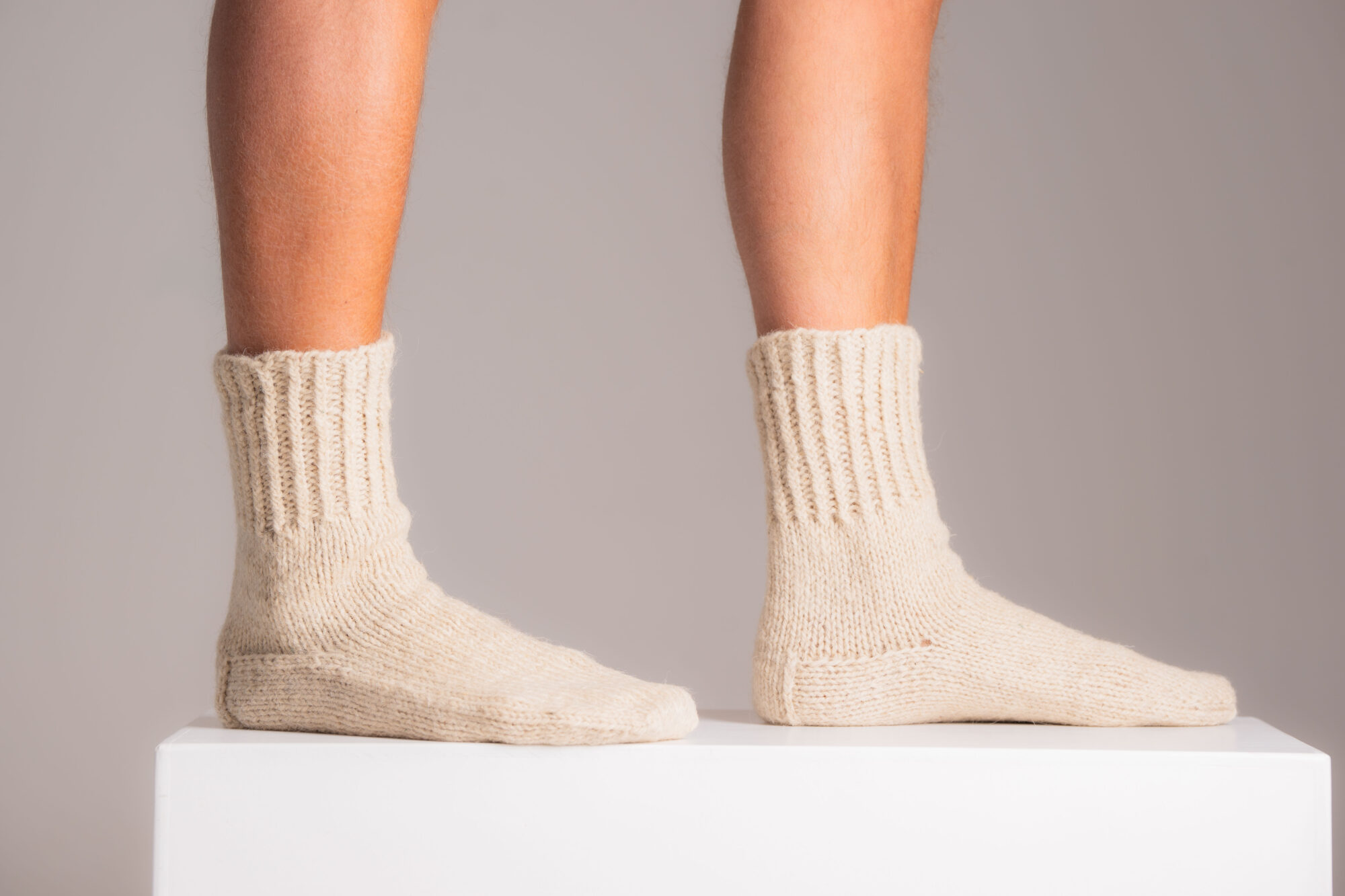
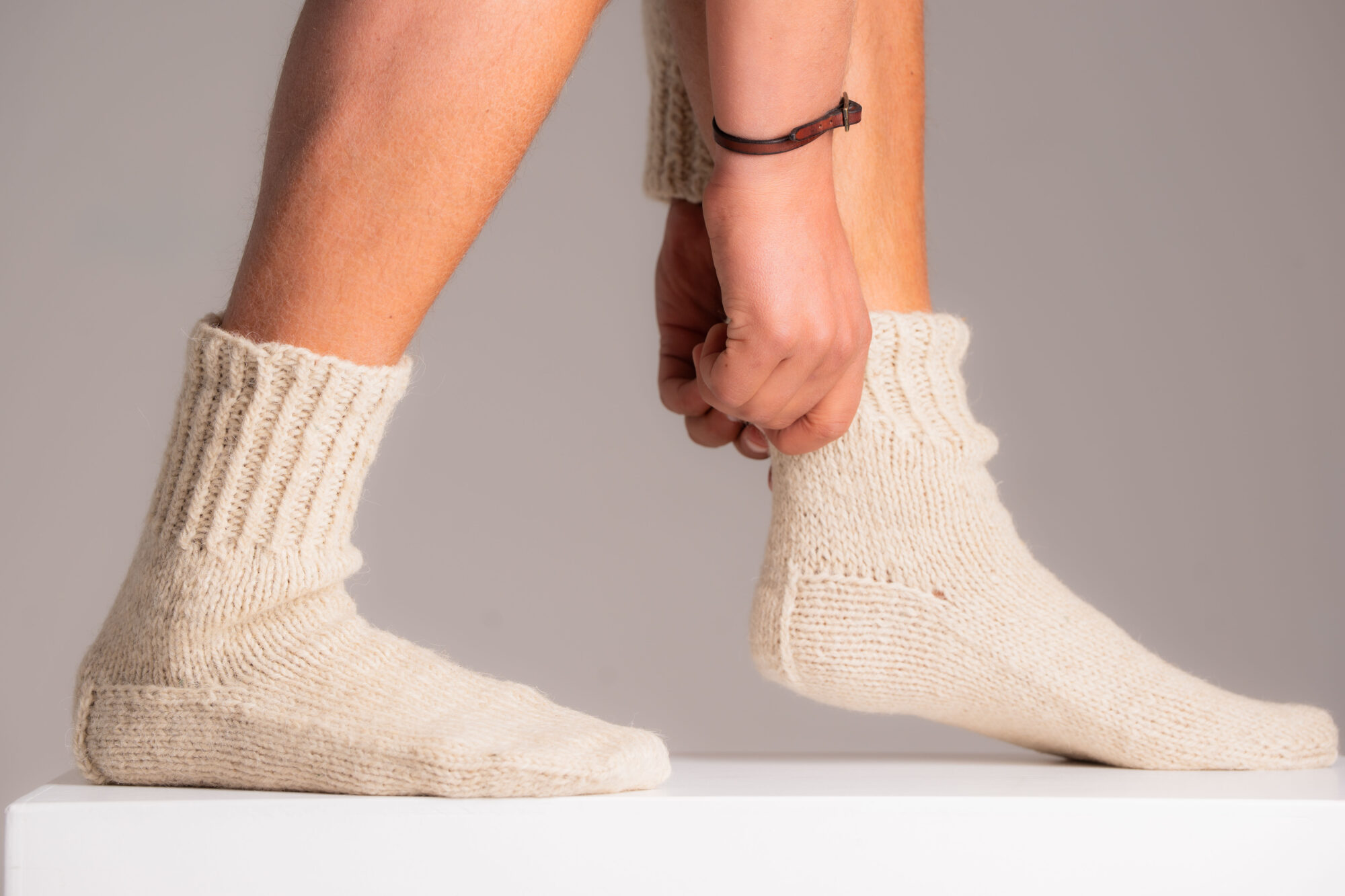
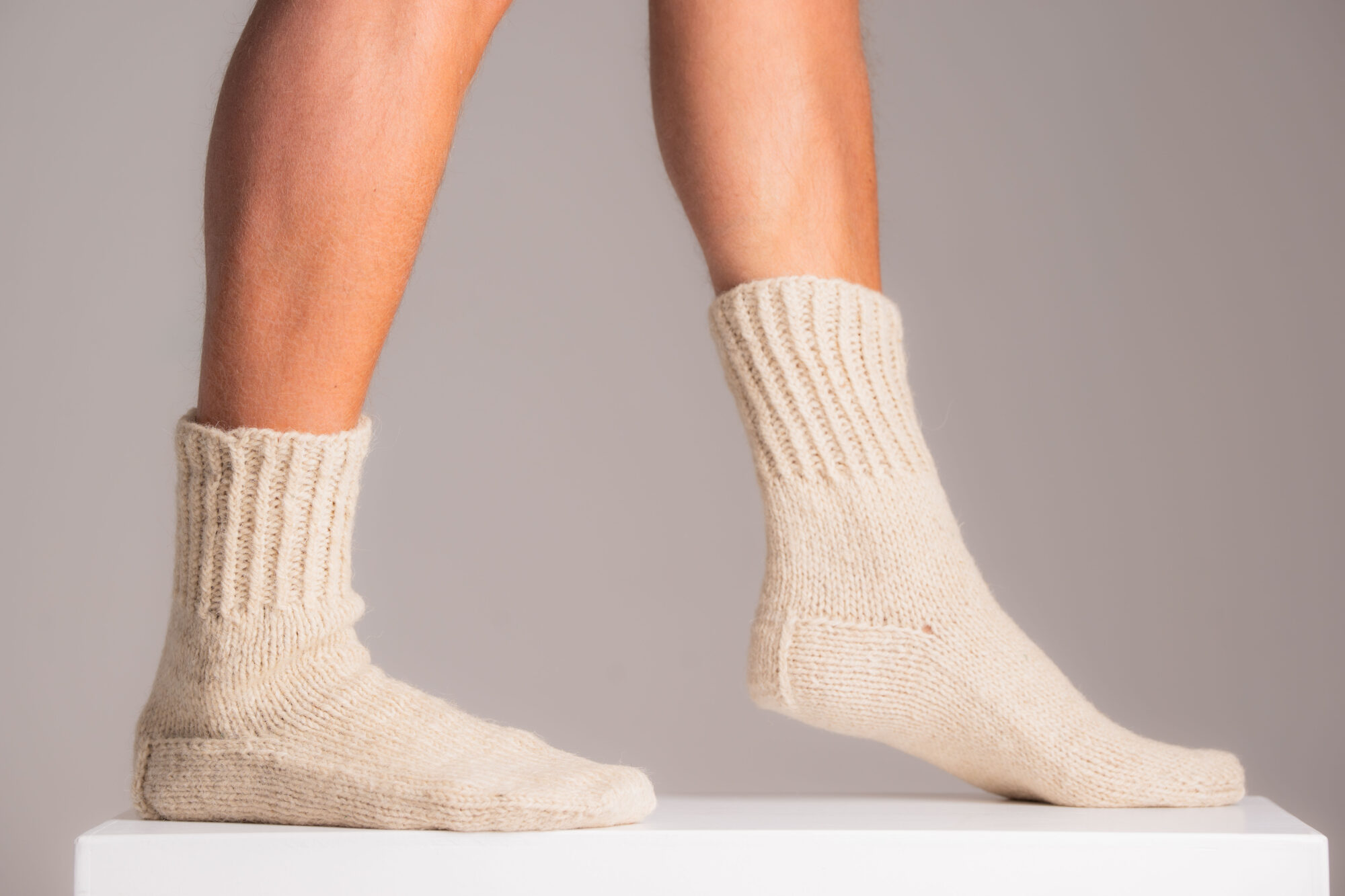
Those winter mornings when it took me three minutes to put on four pairs of socks are a thing of the past.
Hand-knitted in Georgia with the same wool as the the chunky chunky sweater, by the same wool artisans, in the same mountain village. To avoid repeating everything and to keep only the essential information here, please refer to the chunky chunky sweater page for details about this wool and its production.
Reinforced heel for added durability. Truly strong, reliable, and long-lasting socks.
They are rough, yes, but for the socks—and less so for the thick, rough sweater—I wear them directly against my skin. They don’t itch after a few days of wear (whereas the sweater does itch if I’m not wearing anything underneath). I understand, however, that this may be my personal experience and not shared by all customers.
Size: We prepare each pair of socks before our sales periods, using proportions designed to fit most feet. However, if your foot shape falls outside this range, we will make the necessary adjustments specifically for you. After you place your order, we will contact you personally to discuss your shoe size and wearing preferences—more fitted, more enveloping, or higher—to guarantee optimal comfort from the very first use. The socks are thus adapted to your feet and how you wear them, and not the other way around. You can order with complete peace of mind, without worrying about choosing the right size: in any case, you’ll receive a perfectly fitting pair, tailored to your preferences.
If it’s a surprise gift, don’t worry, we’ll discuss it with you to maximize the chances of the recipient being delighted upon receipt. For reference, I wear a size 43–46.
You benefit from a 60-day satisfaction guarantee after the shipping date of your order, the terms of which are listed below.
Composition: 100% mountain sheep’s wool (Tushuri breed, Georgia).
No machines used, no chemical additives, no plastic substances.
We don’t need three pairs of socks a day (which I did for years during the winter), nor 15 pairs per winter.
Perfect for workouts.
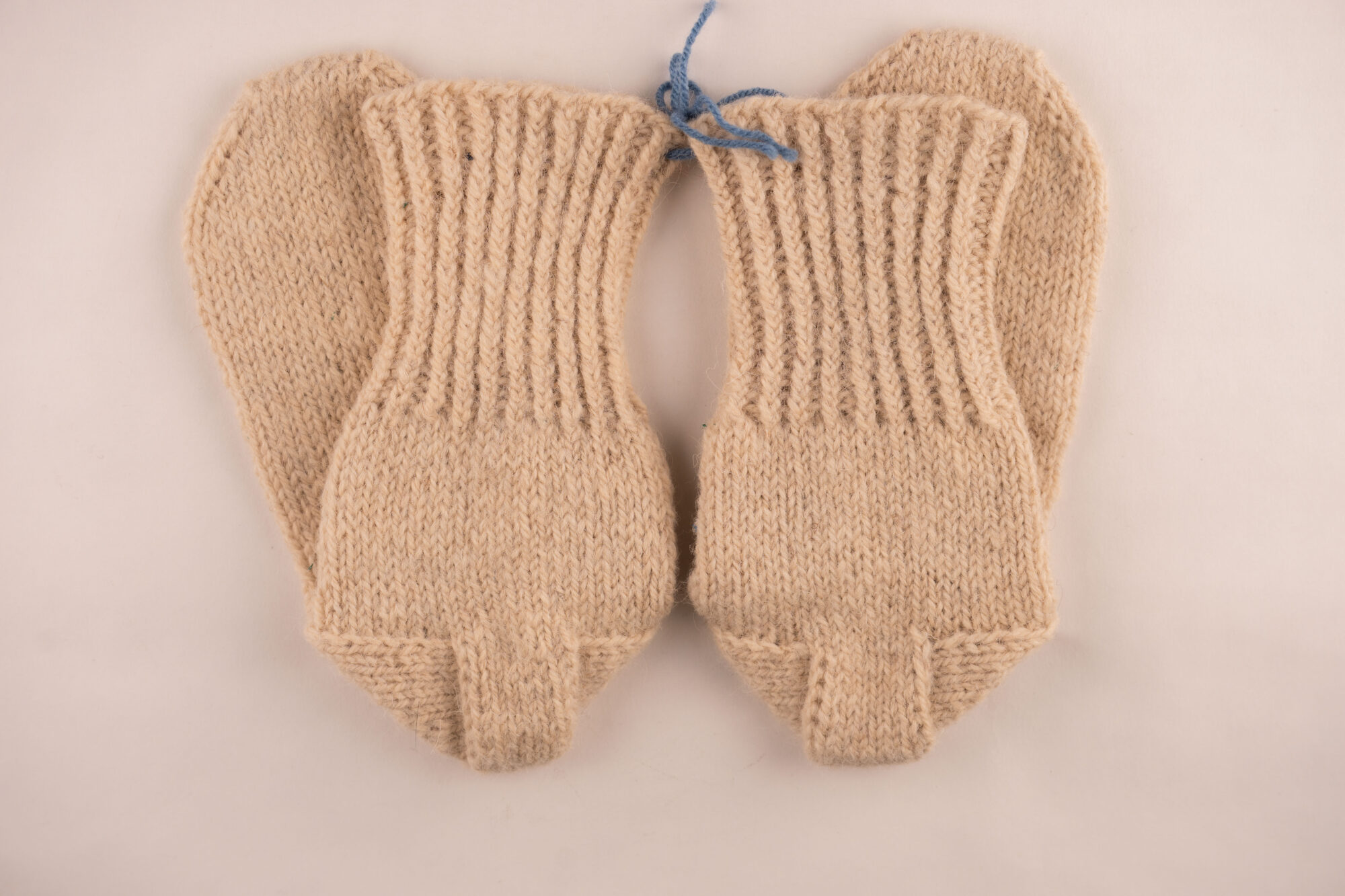
To ensure they stay together until you receive them, the socks are joined by a randomly colored wool thread. Upon receipt, we recommend removing it very carefully: do not pull perpendicular to the wool.
Obviously unisex.
The placement and appearance of the Loïs Kedochim logo may vary from the photographs; however, it will always remain discreet. The product itself may also vary very slightly. Variations in our products reflect their natural origin and handcrafted nature. By purchasing our products, you consent to this possibility. On our wool pieces, our logo is laser-etched onto a strip of Georgian leather, which is itself discreetly embroidered onto the garment. To care for your socks, please consult our guide.
After two months of intensive, real-world use, these socks have revealed two natural changes in the wool.
– When worn directly against the skin for the first few days, the wool may cause a slight itchy sensation, but only for the first three or four days; this sensation then disappears completely.
– Furthermore, the fiber relaxes very slightly over time, while maintaining remarkable strength: no wear has appeared at the heels or toes, where other wool socks usually break. Therefore, if the socks seem tight at first, almost difficult to put on, the size is actually perfectly fitted.
A word about the village where these socks are made.
The main source of livelihood for the inhabitants of this village in Kakheti is agriculture. Traditional practices like potato farming and sheep herding thrive here. The local state farm specializes in raising Tushuri sheep, a breed renowned for its hardiness and high-quality wool. But more than just an agricultural village, this mountain region plays a central role in preserving the surrounding natural areas, coordinating the management of a national park recognized for its rare biodiversity and its appeal to researchers and travelers from around the world.
A word about my sensitivity to the cold.
You might picture me bathing in icy rivers at high altitudes, but before that, I lived in Switzerland, and before that in Besançon (a very cold city, whose city center is surrounded by the Doubs River), and before that, in Lyon. When I lived in Lyon, I was incredibly sensitive to the cold, all over, my whole body, but I worked on overcoming this weakness thanks to a robust friend (nickname: Spartacus) with whom I cycled thousands of kilometers. In Besançon, cycling to work at the hospital, I began to resist the cold more and more effectively. Why am I telling you this? Because the common thread throughout all these periods of my life, and still today, is that I’m incredibly sensitive to the cold in my feet. I even had a foot warmer for working on the computer when I lived in France and Switzerland. Today, I still get cold feet, but thanks to these socks and hot showers before bed, I no longer need a foot warmer (anyway, I didn’t want to check luggage for that device).